- Home
- Storage 101
- What is BESS
What is BESS?
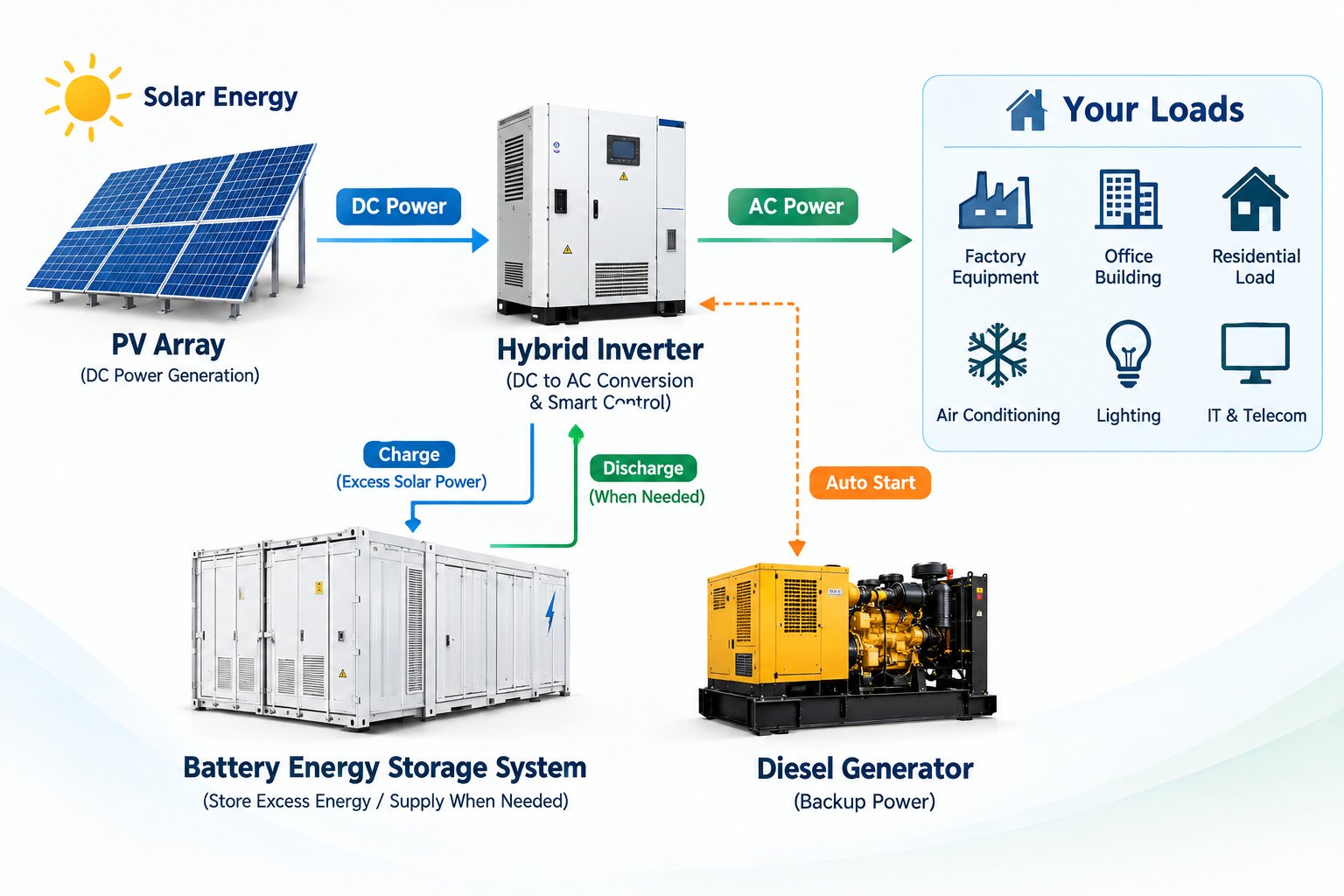
How a battery energy storage system works, in one diagram
A BESS (Battery Energy Storage System) is the complete system that stores electricity and releases it when needed. It's not a single battery, but a set ofcells, BMS, PCS, EMS, transformer, switchgear, thermal management and fire suppressionand other subsystems working together — a power warehouse. The diagram below shows a typical hybrid energy system: how solar, BESS and a diesel generator cooperate to supply stable power to factories, commercial buildings and homes.
Understand BESS in Four Steps
Break the diagram into 4 actions: generate, convert, store, discharge.
Generate · Charge
The PV array converts solar energy into direct current (DC), sent to the hybrid inverter. Surplus power charges the BESS, saving daytime energy for night and cloudy days.
Convert · Convert
The hybrid inverter turns DC into alternating current (AC)for direct use by factories, commercial buildings and homes. It also manages the grid and on/off-grid switching.
Store · Store
LiFePO4 cells make up the BESS container; the BMS monitors each cell's voltage, current and temperature in real time to ensure 6,000+ cycle life.
Discharge · Discharge
When loads demand it, the grid is down or tariffs peak, the BESS discharges to supply loads; if the grid fails completely, the diesel generator Auto Start auto-starts as backup.
Four Core Components Inside a BESS
Laypeople see a container; experts look at these four things. Each determines the system's stability, safety and life.
1. Battery Cells
The heart of storage. The industry mainly uses LiFePO4 (LFP)much safer than NMC: thermal runaway temperature >270°C, won't self-ignite, survives nail penetration. We use only Grade A cells, with maker test reports per batch.
Typical specs:3.2V / 100–280Ah · Cycle life 6,000+ @80% DoD · Life 15–20 years
2. BMS Battery Management System
The cells' personal caretaker. Real-time acquisition of each cell'svoltage, current, temperature, SOC (state of charge) and SOH (state of health), detecting anomalies within 3 seconds and triggering protection: overvoltage, overcurrent, overtemperature, short circuit.
A battery pack without a BMS = a high-risk bomb. No storage system should skimp on the BMS.
3. PCS Power Conversion System
The translator between DC ↔ AC.Chargingrectifies AC to DC into the battery;Discharginginverts DC to AC for loads or the grid. C&I uses 50kW–630kW modular PCS; residential is integrated into the hybrid inverter.
Key metrics:Conversion efficiency ≥97.5% · Seamless on/off-grid switching <20ms
4. EMS Energy Management System
The brain of the whole system. Based ontariffs, load forecasts, PV output and battery SOCit decides automatically when to charge, discharge or switch to the diesel generator. 80% of commercial BESS ROI comes from EMS optimization.
Common strategies:Peak shaving, demand management, backup, self-consumption。
Where is BESS Used?
From home rooftops to factory floors, from island microgrids to data centers, these 5 scenarios cover 90% of overseas BESS demand.
Home Storage & Backup
5kWh–30kWh stacked modules with rooftop PV for villas, emergency households and outage-prone areas. 10-year warranty, IP65 for indoor and outdoor use.
View EH Residential Series →C&I Peak Shaving
100kWh–1MWh peak shaving, lower demand charges, demand response participation — 4-year payback is the norm. Ideal for factories, malls and offices.
View EC C&I Series →Microgrid & Off-Grid
Solar + diesel + BESS hybrid microgrids forislands, mines, oilfields and remote villages. Figure 1 shows this typical topology.
View Microgrid Solutions →Residential PV + Storage
PV charges the battery by day and discharges at night,Raise self-consumption from 30% to 80%, cutting your bill in half.
View EH PV + Storage →Data Center Backup
Replacing lead-acid UPS: 1/3 the footprint, 3× the life, better discharge curve. Lithium UPS is the default for new data centers.
View EC Backup Solutions →EV Charging Station Storage
Ultra-fast stations with BESS for peak shaving,save transformer upgrade fees + demand charges, with 1MWh + four 360kW chargers a typical ratio.
View Charging Station Solutions →Why do all BESS use LiFePO4 instead of NMC?
Home storage, C&I storage and microgrids are almost universally LiFePO4 (LFP). The reason is one word:STABLE。
- No Fire: thermal runaway >270°C — no ignition on nail penetration, crush or overcharge; NMC can ignite at 150°C
- Long Life: 6,000+ cycles @80% DoD, 15–20 years of service life
- Heat Tolerant: full power at 55°C ambient with no derating, no restrictions on install location
- Affordable: since 2024 LFP cell costs have matched lead-acid, with 10× the cycles

Starting a project? Send us 4 parameters
Load type, peak power, daily consumption and local tariff. Get a selection plan + factory price within 24 hours. If it doesn't add up, we'll say so — no wasted time.