How to Choose a BMS for Commercial & Industrial Energy Storage? A Selection Checklist from Sampling and Protection to Communication
A BMS for commercial and industrial energy storage does more than monitor batteries: sampling, protection, SoC estimation, and communication interfaces all affect system commissioning and long-term operation. This article provides an actionable pre-purchase selection checklist.
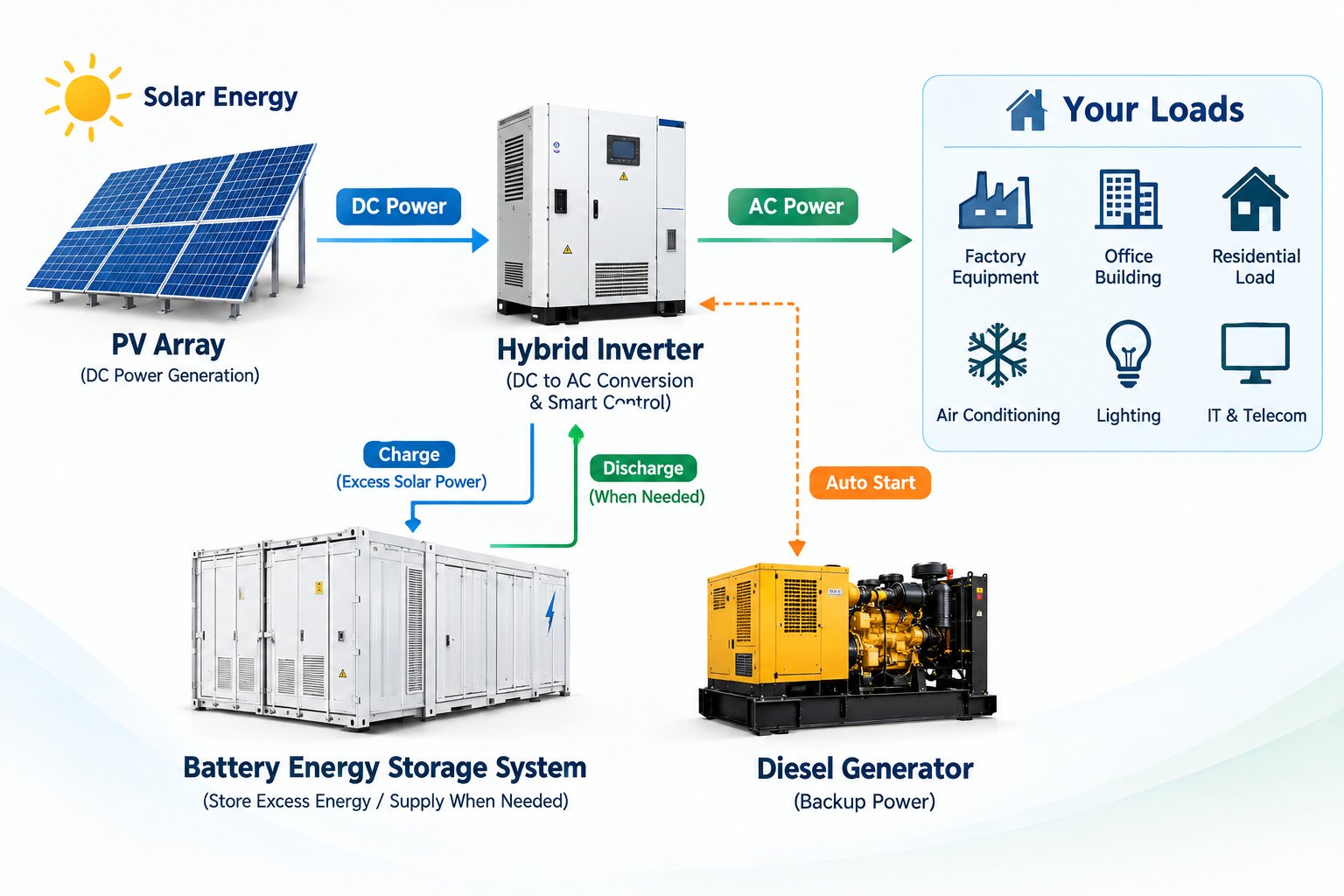
In commercial and industrial energy storage projects, battery cells, PCS, and energy storage cabinets are often the most visible, but the BMS is the control layer that continuously monitors battery status. When procuring, comparing only system capacity or cell parameters can easily overlook the BMS's sampling accuracy, protection logic, and communication boundaries. A truly actionable selection should be derived backward from the project's operating conditions and acceptance interfaces, rather than just looking at a parameter table.
First clarify the BMS's position in the energy storage system
The BMS, or battery management system, is responsible for collecting status such as cell voltage, temperature, current, and insulation, and based on this estimating SoC, issuing alarms, or executing protection. In an energy storage system, the BMS also needs to transmit allowable charge/discharge power, status, and fault information to the PCS, EMS, or host computer. It is not a component that works alone: the interfaces among battery clusters, cabinet-level control, converters, and energy management strategies must be confirmed at the design stage.
Determine the sampling and monitoring scope from actual operating conditions
First organize the project's battery configuration, daily charge/discharge cycles, ambient temperature, installation space, and operation and maintenance approach. In locations with high temperature, dust, humidity, or limited ventilation, there are higher requirements for temperature monitoring point placement and alarm handling; for scenarios with rapid load changes, attention should be paid to whether data refresh, power limit issuance, and event recording meet operational needs. Buyers should require suppliers to explain the collection target, refresh frequency, and abnormal-condition determination criteria for each type of data, rather than treating "has monitoring function" as a sufficient description.
Protection logic must be able to interlock with the system
Protection such as overvoltage, undervoltage, overcurrent, overtemperature, and abnormal temperature difference is not more sensitive is better; the key is that thresholds, delays, and tiered actions are consistent with battery specifications and PCS control strategies. It is recommended to list actions such as early warning, first-level alarm, power derating, and cutoff separately in the technical agreement, and clarify who is responsible for execution, which states can recover automatically, and which states require manual inspection. This can avoid frequent shutdowns due to small fluctuations and also prevent abnormalities from being simply masked.
The use of SoC and SoH depends on methods and boundaries
SoC represents the estimated result of currently available energy and directly affects charge/discharge scheduling; SoH is used to describe battery health status and is usually related to factors such as capacity fade and internal resistance changes. Neither is a fixed number divorced from conditions. During selection communication, ask how the BMS corrects estimates under different temperatures, rest, or charge/discharge conditions, and whether the data is traceable. For projects that need peak-valley arbitrage or peak shaving and valley filling, the scheduling strategy should leave a reasonable safety margin for SoC to avoid long-term operation in an unsuitable working range.
Communication protocols and point tables must be aligned in advance
Commissioning of energy storage systems often gets stuck on communication rather than hardware installation. Before placing an order, confirm the communication interfaces, protocol versions, point tables, read/write permissions, and fault code definitions between the BMS and the PCS, EMS, fire protection, and monitoring platform. Also agree on the default strategy upon loss of communication: whether to limit power, stop charging and discharging, or maintain the last command. The same protocol name does not mean the data meanings are consistent, so point tables, units, ranges, positive/negative directions, and timestamps should all be checked item by item before commissioning.
Focus on fault records, permissions, and O&M visibility
A BMS suitable for long-term operation should retain key events and trend data to help O&M personnel trace voltage, temperature, current, and communication status before and after alarms occur. Buyers should also clarify account permissions for remote access, log retention, upgrade procedures, and on-site service boundaries. Software upgrades should have version records and rollback plans, and protection parameters should not be changed directly on a running system without evaluation.
Write acceptance clauses as testable items
Avoid descriptions such as "fully featured" and "good compatibility" that are difficult to accept. A more actionable approach is to list BMS sampling display, alarm grading, protection interlocking, communication point tables, historical records, and exception recovery as test items, and verify them separately at the factory and on site. For OEM/ODM projects, also confirm which data the system integrator, equipment supplier, and final owner can each view and modify.
Selection checklist: confirm at least eight things before procurement
First, the monitoring targets and accuracy requirements at the battery cluster and cabinet levels; second, temperature sensor placement and exception handling; third, the estimation logic and display range of SoC and SoH; fourth, protection thresholds, delays, and tiered actions; fifth, the communication protocols and complete point tables between the BMS and PCS, EMS; sixth, safety strategies after communication loss, power failure, and restart; seventh, event recording, remote O&M, and permission management; eighth, the responsibility boundaries for factory testing, on-site commissioning, and software upgrades. Only by writing these into the technical agreement can the energy storage system have a clear control basis after commissioning.
Conclusion
The core of BMS selection is not the pursuit of a single parameter, but making sampling, protection, communication, and O&M form a closed loop. The earlier the project party clarifies the interface and acceptance requirements, the lower the uncertainty in subsequent debugging and operation. For selection materials, please contact Haisi Electric.