How to Commission Commercial & Industrial Battery Storage: Delivery Tests, Commissioning & Documentation Checklist
C&I battery storage delivery is more than powering up the equipment. This article outlines the acceptance checklist covering supply scope, capacity and power tests, communication integration, protection interlocks, trial operation, and documentation handover.

Installing a C&I energy storage system doesn't mean it's ready to go live. The real handover milestone is this: clear equipment boundaries, verifiable test results, coordinated protection and communications, and traceable documentation and responsible parties. Leaving commissioning to the end of the project often surfaces problems such as configuration mismatches, missing point lists, or unclear lines of responsibility. This article lays out a C&I energy storage acceptance approach you can write into procurement contracts and site plans.
Lock down the scope of supply and configuration version before acceptance
The first step in acceptance isn't powering up—it's verifying that the contract, technical agreement, equipment nameplates, and factory documentation all point to the same configuration. Confirm whether the battery system, PCS, BMS, EMS, distribution components, thermal management, fire protection interfaces, monitoring terminals, and on-site installation services are each included in this scope of supply. For optional items and third-party equipment, also specify the interfaces, supplier, and responsibility for integrated commissioning, so that "system included" isn't misread as "all steps performed by a single party."
Verify capacity and power ratings separately
Rated energy and rated power answer different questions: the former concerns how much energy can be stored or released under given conditions, while the latter concerns how much power can be delivered or absorbed per unit of time. Acceptance documents should specify the ambient conditions during testing, initial SoC, charge/discharge limits, test duration, and data sampling method. Don't rely on a single number on the monitoring screen; retain exportable raw records and state the measurement basis.
Confirm protection, alarm, and interlock actions
Energy storage system safety control relies on tiered alarms and protection interlocks. On site, follow the approved test plan to verify that key states are recognized, alarms display correctly, power is limited according to strategy, and the appropriate equipment executes when disconnection is required. Testing should not arbitrarily modify protection thresholds on the operating system; if simulation is truly needed, use a safe method confirmed by the project owner and retain parameter and restoration records before and after testing.
Communications commissioning is more than checking "online" status
BMS, PCS, EMS, and on-site monitoring platforms showing online only proves the link exists—it doesn't prove the data and control logic are correct. During acceptance, spot-check key point lists: units, direction, range, and refresh behavior for status, power, SoC, alarms, fault codes, and timestamps; also verify control command permissions and feedback. Agree on default strategies for communication loss, network recovery, and system restart to ensure the system doesn't enter an indeterminate state due to interface anomalies.
Break commissioning into signable stages
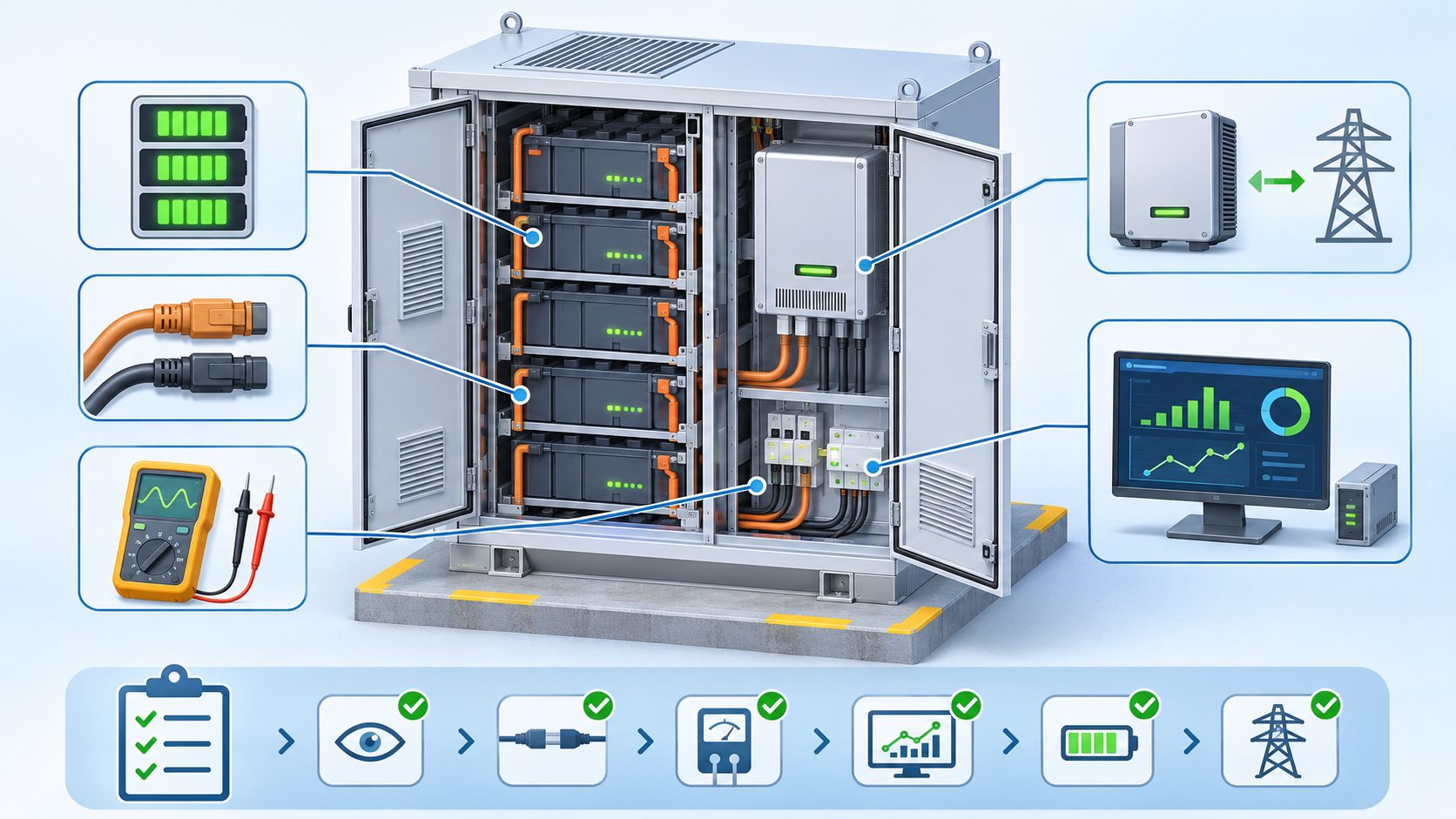
We recommend dividing commissioning into five stages: incoming inspection, individual equipment checks, subsystem integrated commissioning, full-system trial run, and handover confirmation. Each stage should list prerequisites, executors, witnesses, record items, and closure criteria for failed items. This makes it easier to coordinate the installer, equipment supplier, and owner, and avoids discovering basic wiring, communication address, or software version mismatches only during the full-system trial run.
Factory and site documentation should be handed over as a complete set
Deliverables shouldn't be just a single manual. The project owner should receive, per the agreement, the equipment list, version information, wiring or interface documentation, operation and maintenance instructions, alarm and fault code descriptions, test records, commissioning records, and warranty and service contact information. Where software or remote platforms are involved, also record account permissions, log access methods, upgrade procedures, and change history. Documentation should correspond to the actual delivered configuration, not generic marketing materials.
Trial operation focuses on stability and traceability
During the trial run, observe charge/discharge, alarms, temperature, communications, and shutdown/restart behavior according to the agreed operating strategy. The focus isn't chasing a single impressive instantaneous reading—it's confirming that data is continuous, events are traceable, and anomalies have a clear resolution path. If alarms occur, record the conditions, resolution process, and retest results; unresolved issues should be listed in a punch list with assigned responsible parties and completion dates.
Write after-sales response and warranty boundaries into the acceptance record
Acceptance doesn't replace ongoing O&M. The buyer should clarify the fault reporting channel, the boundary between remote and on-site support, consumable or spare parts arrangements, and how software versions are maintained. Warranty terms, exclusions, and data retention responsibilities need to match the actual operating environment. Any commitment should be documented in the contract and written materials confirmed by both parties—avoid substituting verbal statements for enforceable service terms.
A practical site acceptance checklist
On site, check eight items in order: first, equipment and scope of supply; second, installation and appearance; third, parameters and configuration version; fourth, basic checks such as electrical connections and insulation; fifth, BMS, PCS, and EMS communication point lists; sixth, alarm, protection, and interlock testing; seventh, trial operation and data archiving as agreed; eighth, handover documentation, punch list, and after-sales contacts. Specific test items for different projects should be jointly confirmed by the designer, equipment supplier, and owner based on local requirements.
Conclusion
The goal of C&I energy storage acceptance isn't to complete a signature sheet—it's to confirm that equipment, controls, data, and responsibilities form a closed loop after commissioning. The earlier the test basis and handover documentation are clearly defined, the less uncertainty there will be later in the project. For selection materials, please contact Haisi Power.